
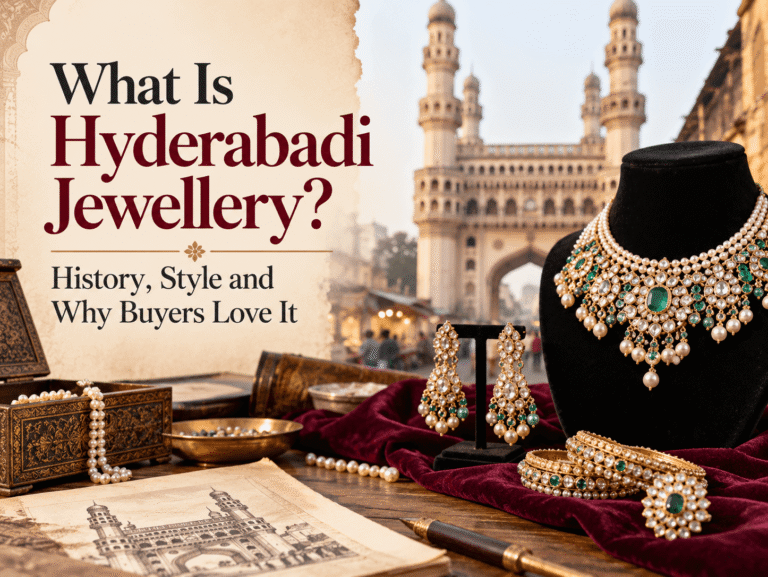
Some jewellery is made to be worn. Some is made to be remembered. Hyderabadi jewellery belongs to the second group.
Known for its rich gold work, lustrous pearls and colourful gemstones, Hyderabadi jewellery carries the grandeur of the Deccan courts. Today it remains one of the most admired traditional styles in India, especially for bridal and festive occasions, and it is gaining attention among international buyers who look for authentic handcrafted pieces.
This guide explains what Hyderabadi jewellery is, where it comes from, what makes it unique and why retailers and designers love adding it to their collections.
What Is Hyderabadi Jewellery?
Hyderabadi jewellery refers to the traditional jewellery style associated with the city of Hyderabad and the former Hyderabad state, once ruled by the Nizams. It blends influences from Deccan, Mughal and Persian design traditions with local Indian craftsmanship.
It is typically recognised by:
- Generous use of gold, often in a warm, rich tone
- Pearls, which are central to the Hyderabadi look
- Gemstones such as emeralds, rubies and diamonds
- Detailed hand-finished work
- Bold, regal designs, especially in necklaces, chokers and bridal sets
Hyderabad is often called the “City of Pearls,” and pearls remain one of the most important elements of its jewellery tradition.
A Brief History of Hyderabadi Jeweller
The Golconda connection
Hyderabad is closely linked with the historic Golconda region, which was famous for diamonds for centuries. Golconda stones are associated with some of the most celebrated diamonds in history, and the region helped build Hyderabad’s reputation as a centre of gems and fine jewellery.
The Qutb Shahi and Nizam eras
Under the Qutb Shahi dynasty, which founded Hyderabad in the late 16th century, and later under the Asaf Jahi rulers (the Nizams), the city became a major centre of art, culture and craftsmanship. Royal patronage encouraged goldsmiths, enamellers, gem cutters and pearl specialists, and these artisans developed distinctive styles over generations.
Influence of different cultures
Hyderabadi jewellery draws on several traditions: Mughal court styles, Persian motifs, South Indian temple jewellery and local Deccani design. The result is a unique look that feels both regal and rooted in India.
The pearl trade
Pearls became a defining feature of the city. Hyderabad developed a strong reputation for pearl trading, drilling, stringing and setting, and pearls continue to feature in many of its signature designs.
(Note: Historical details are summarised here for general understanding. For publication, you may add your own family or workshop heritage, which will make the content more authentic.)
Key Features of Hyderabadi Jewellery
1. Pearls as the centrepiece
Natural, cultured and freshwater pearls are used in strands, clusters and drops. Multi-strand pearl necklaces are among the most iconic Hyderabadi designs.
2. Jadau and Kundan craftsmanship
Jadau (also called Kundan Jadau) is a traditional technique where stones are set into gold using a gold foil or lac setting, often giving the piece a rich, polished look with detailed work on the reverse.
3. Nakshi work
Nakshi refers to fine, hand-engraved or embossed gold work, often with floral, peacock and temple-inspired motifs. It adds texture and depth to pendants, bangles and necklaces.
4. Meenakari (enamel)
Colourful enamel work is often added to the reverse of a piece or within the design, so the jewellery looks beautiful from every angle.
5. Polki and uncut diamonds
Uncut or lightly cut diamonds (polki) give pieces a raw, antique glow that is very popular in bridal jewellery.
6. Emeralds, rubies and coloured stones
Deep greens, reds and other coloured gemstones create the rich, royal colour palette people associate with Hyderabadi jewellery.
7. Warm, rich gold tone
Hyderabadi jewellery is traditionally made in high-carat gold, which gives it its distinctive warm appearance.
Popular Hyderabadi Jewellery Designs
| Design | Description |
|---|---|
| Satlada / Multi-strand pearl necklace | A classic, layered pearl necklace, often with a decorative centre or pendant |
| Choker | A close-fitting necklace with gold work, pearls or stones |
| Long haar (long necklace) | A long, statement necklace worn with traditional or bridal outfits |
| Jhumka and Chandbali earrings | Dome-shaped or crescent-shaped earrings, often with pearl drops |
| Maang tikka and Matha patti | Forehead ornaments worn at the parting of the hair |
| Bangles and Kadas | Heavy gold bangles, often with Nakshi, Jadau or enamel work |
| Haathphool | A hand ornament linking a ring to a bracelet |
| Rings | Cocktail-style or traditional rings with stones and pearls |
| Bridal sets | Complete matching sets of necklace, earrings, tikka and bangles |
(You can adjust this list to match the exact designs available in your collection.)
Why Buyers Love Hyderabadi Jewellery
1. Timeless heritage
It has a story. Customers love knowing that a piece is inspired by a tradition with centuries of history.
2. Strong bridal and festive demand
Weddings and festivals drive steady demand for statement necklaces, sets and traditional pieces.
3. Rich craftsmanship
The detail, layering and finishing make each piece look and feel premium, which supports higher perceived value.
4. Versatile pairing
Hyderabadi designs work with sarees, lehengas, sherwanis and fusion outfits, so they appeal to a wide range of customers.
5. Global appeal
Customers in the Middle East, the UK, the USA and other markets with large Indian communities, as well as collectors of traditional jewellery, are drawn to authentic Indian craft.
6. Gift and heirloom value
These pieces are often bought for weddings, anniversaries and as family heirlooms, which makes them a meaningful, long-lasting purchase.
Hyderabadi Jewellery vs. Other Indian Styles
| Style | Key characteristics |
|---|---|
| Hyderabadi | Pearls, Jadau, Nakshi, warm gold, regal Nizami look |
| Rajasthani / Jaipur | Kundan, Meenakari, Polki, vibrant colour |
| South Indian temple | Deity motifs, intricate gold work, often with ruby and emerald |
| Bengali | Delicate gold filigree, lighter designs |
| Victorian / Art Deco (Western) | Antique-inspired, intricate stone and metal detail |
In practice, there is often overlap. Many craft techniques travel between regions, and jewellers combine elements to create fresh designs.
Hyderabadi Jewellery in Modern Collections
Today’s jewellery brands are modernising the style:
- Lighter-weight pieces that keep traditional motifs but cost less
- Modern silhouettes such as minimalist chokers and smaller jhumkas
- Mix-and-match sets that can be worn separately
- Fusion designs that combine Hyderabadi details with contemporary styling
- Mixed metals and stones to suit different budgets
This helps retailers offer both traditional and contemporary options to the same customer.
Tips for Retailers and Designers Buying Hyderabadi Jewellery
- Check craftsmanship carefully. Look at the reverse side, the stone setting and the finishing.
- Verify gold purity and hallmarking. Ask for hallmark details and purity documentation.
- Ask about stone and pearl quality. Confirm whether stones are natural, treated or synthetic, and whether pearls are natural, cultured or freshwater.
- Understand weight and pricing. Traditional pieces are often heavier, so clarify how metal rate and making charges are calculated.
- Request samples and custom options. Many manufacturers can adapt designs, sizes or stone choices to your market.
- Match to your audience. Bridal customers may want heavy sets, while younger buyers may prefer lighter modern interpretations.
- Work with an experienced manufacturer. Hand-finished jewellery needs skilled artisans and consistent quality control.
About Bhavya Gems & Jewels
Bhavya Gems & Jewels is a B2B jewellery manufacturer and wholesaler based in Jaipur with over 30 years of experience. Along with Fine Gold and Victorian / Art Deco jewellery, Hyderabadi jewellery is one of our core specialities, produced with careful design, stone selection and quality testing.
Explore our Hyderabadi jewellery collection, browse our necklaces and earrings, learn about our manufacturing process, or send us an enquiry for wholesale and custom orders.
Factory: G-42 (A) E.P.I.P. Jewellery Zone, Sitapura, Jaipur 302022
Email: bhavya@bhavyagemsandjewels.com | Phone: +91 96360 37445
FAQs
Q1. What is Hyderabadi jewellery known for?
It is known for rich gold work, pearls, Jadau and Nakshi craftsmanship, and regal designs inspired by the Nizam era and the Deccan region.
Q2. Why are pearls important in Hyderabadi jewellery?
Hyderabad has long been known as a pearl trading and pearl jewellery centre, so pearls became a signature element of its jewellery tradition.
Q3. What is the difference between Kundan, Jadau and Polki?
Kundan refers to the foil-backed setting technique, Jadau is the broader traditional craft of setting stones in gold, and Polki refers to uncut or minimally cut diamonds. They are often combined in a single piece.
Q4. Can Hyderabadi jewellery be made in lighter weight?
Yes. Many manufacturers create lighter, more affordable interpretations that keep the traditional look.
Q5. Is Hyderabadi jewellery popular outside India?
Yes. It is popular among South Asian communities worldwide and among buyers who appreciate authentic handcrafted jewellery.
Q6. Can I order custom Hyderabadi designs wholesale?
Many B2B manufacturers offer custom designs, private label options and bulk orders. Confirm MOQ, timelines and sampling details with your supplier.