
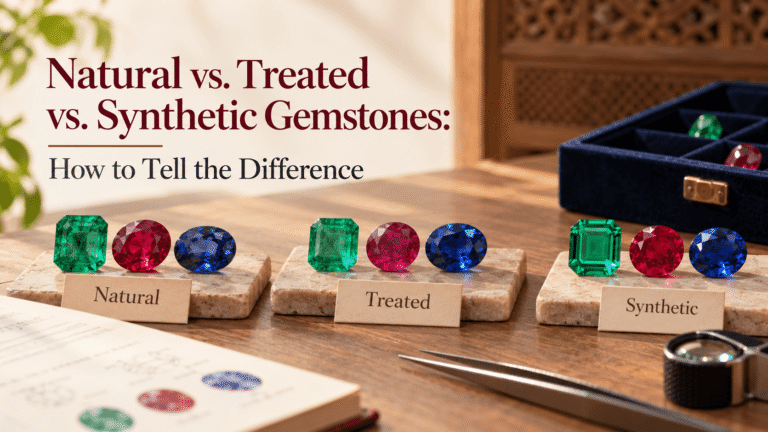
Two gemstones can look almost identical and still differ in price by a factor of ten or more. The reason is usually one of three things: one stone is natural and untreated, one has been enhanced, or one was grown in a laboratory.
For jewellery retailers, designers and wholesale buyers, understanding these categories is essential. It protects your margins, your customers and your reputation. This guide explains each type in plain language and shows you how to buy with confidence.
The Four Categories You Need to Know
1. Natural, Untreated Gemstones
These formed in the earth and have only been cut and polished. Nothing has been done to improve their colour or clarity. Fine quality natural untreated stones are the rarest and typically the most valuable, especially in ruby, sapphire and emerald.
2. Natural, Treated Gemstones
These are also mined from the earth, but they have been enhanced to improve appearance. Treatment is extremely common in the trade, and many treatments are widely accepted. What matters is disclosure: the buyer must know what has been done.
3. Synthetic (Lab-Grown) Gemstones
These are created in a laboratory and have essentially the same chemical composition, crystal structure and physical properties as their natural counterparts. A lab-grown ruby is still a ruby in chemical terms. The difference is origin, which affects rarity and price.
4. Imitations (Simulants)
These only look like a gemstone but are made of different material, such as glass, plastic or cubic zirconia, or even a different natural stone passed off as another. They have a different chemical composition from the stone they imitate.
Important: “Synthetic” and “imitation” are not the same thing. A synthetic stone is the real material made by humans. An imitation is a look-alike made of something else.
Common Gemstone Treatments
| Treatment | What it does | Typical stones | Acceptance in trade |
|---|---|---|---|
| Heat treatment | Improves colour and clarity | Ruby, sapphire, tanzanite, aquamarine, topaz | Widely accepted when disclosed |
| Oiling or resin filling | Fills surface-reaching fractures to improve clarity | Emerald | Widely accepted, level should be disclosed |
| Fracture or glass filling | Fills larger fractures with glass-like material | Ruby and others | Lower value, must be clearly disclosed |
| Diffusion treatment | Adds colour-causing elements to the surface layer | Sapphire and others | Requires clear disclosure, often much lower value |
| Irradiation | Changes or deepens colour | Topaz, diamond, others | Disclosure required |
| Dyeing | Adds colour | Jade, pearl, turquoise, quartz | Requires disclosure |
| Coating | Thin colour layer on surface | Various | Requires disclosure |
Treatment is not automatically a negative. A heated sapphire sold honestly as heated is a legitimate and popular product. The problem arises only when a treated stone is sold as untreated, or a lab-grown stone is sold as natural.
How Natural, Treated and Synthetic Stones Differ
Look at the inclusions
A gemmologist uses magnification to examine what is inside a stone. In general terms:
- Natural stones often show irregular inclusions, such as needle-like rutile “silk,” mineral crystals, fingerprint-like patterns and natural growth lines. Natural emeralds, for example, commonly have a mossy internal pattern.
- Flame-fusion synthetics (a common method for synthetic ruby and sapphire) may show curved growth lines and tiny gas bubbles.
- Flux-grown synthetics can show wispy, veil-like or fingerprint-like residues of the growth material.
- Treated stones may show signs of the treatment, such as flattened gas bubbles in filled fractures, altered inclusions after heating, or colour concentrated along the surface.
These clues are useful, but they require training and proper equipment. Some modern lab-grown stones are very clean and can be difficult to identify without advanced testing.
Colour and clarity can be “too perfect”
A stone with unusually intense colour, no inclusions, and a surprisingly low price deserves extra scrutiny. Natural stones of such quality are rare and rarely cheap.
Price is a clue
If a deal looks too good to be true for the size and quality offered, it often is. Fine natural untreated stones carry a premium. Lab-grown and heavily treated stones cost much less.
Why Home Tests Are Unreliable
You may see tips online such as scratch tests, breath tests, water tests or even testing with a flame. These are not recommended. They can damage the stone and they do not give dependable results. Many stones are also made to pass simple tests.
For anything important, rely on professional identification and written reports.
How Professionals Identify Gemstones
Gemmological laboratories and trained gemmologists use a combination of tools, including:
- Microscopes for studying inclusions
- Refractometers for measuring how light bends in the stone
- Spectroscopes for analysing light absorption
- UV fluorescence observation
- Advanced instruments such as FTIR, UV-Vis and trace element analysis for origin and treatment detection
A lab report may state the stone’s identity (natural or synthetic), any detected treatment, and in some cases the geographic origin.
Why Certification Matters
For valuable stones, an independent report from a recognized gemmological laboratory is the best protection for both buyer and seller. It records:
- Whether the stone is natural or synthetic
- Treatment status (none, heated, filled and so on)
- Weight, dimensions and colour description
- Origin, where the lab offers it
Well-known laboratories include GIA, IGI, GRS, SSEF and Gübelin. Which one suits you depends on the stone’s value and your market.
Red Flags When Buying Gemstones
- No treatment information. A good supplier always tells you.
- Price far below market for the quality claimed.
- Vague answers such as “it’s natural” with no documentation.
- Refusal to allow independent testing or lab submission.
- Perfectly clean, vivid stones at unrealistic prices.
- Mismatched parcels, where the sample looks great but the bulk lot looks different.
Best Practices for Retailers and Designers
- Always get disclosure in writing. Treatment and origin details should appear on the invoice or memo.
- Test high-value stones independently. Send important stones to a gemmological lab.
- Sell honestly. Label lab-grown stones as lab-grown and treated stones as treated. Many countries have rules around gemstone disclosure, so check the regulations in your market.
- Educate your customers. Buyers increasingly value transparency, and it builds long-term trust.
- Choose suppliers who test their stones. In-house gemstone selection and lab testing reduce your risk.
Is Treated or Synthetic Always “Worse”?
Not necessarily. It depends on what your customer wants.
- Natural untreated: Best for collectors, investment pieces and premium collections.
- Natural treated: A great balance of beauty and affordability for mainstream jewellery.
- Lab-grown: An appealing choice for budget-conscious or ethically minded buyers who want a real gemstone material at a lower price.
The key is matching the product to the customer and being completely transparent about what it is.
About Bhavya Gems & Jewels
Bhavya Gems & Jewels is a B2B jewellery manufacturer and wholesaler based in Jaipur with over 30 years of experience. Our manufacturing process includes careful gemstone selection and lab testing, so that the stones in your jewellery are exactly what they are described to be.
Explore our gemstone range, learn about our manufacturing process, or send us your requirements.
Email: bhavya@bhavyagemsandjewels.com | Phone: +91 96360 37445
FAQs
Q1. Is a lab-grown gemstone a real gemstone?
Chemically and structurally, yes. A lab-grown ruby has the same composition as a natural ruby. It is not an imitation. It simply formed in a laboratory instead of the earth, and it should always be sold as lab-grown.
Q2. Are treated gemstones fake?
No. Treated stones are natural stones that have been enhanced. Many treatments, such as heating sapphires, are standard in the industry. They should always be disclosed.
Q3. Can I tell a natural from a synthetic stone with the naked eye?
Usually not. Identification generally needs magnification and instruments, and some lab-grown stones need advanced laboratory testing.
Q4. Which gemstones are most commonly treated?
Emerald (oiling), ruby and sapphire (heating), tanzanite and aquamarine (heating), and jade, turquoise and pearls (various treatments) are among the most commonly treated.
Q5. Do all gemstones need a certificate?
Not every stone, but certificates are strongly recommended for valuable stones, especially in ruby, sapphire, emerald and larger gems.
Q6. Is lab-grown gemstone jewellery cheaper to buy wholesale?
Generally yes, lab-grown stones are priced well below comparable natural stones, which gives retailers a way to offer attractive entry-level prices.