
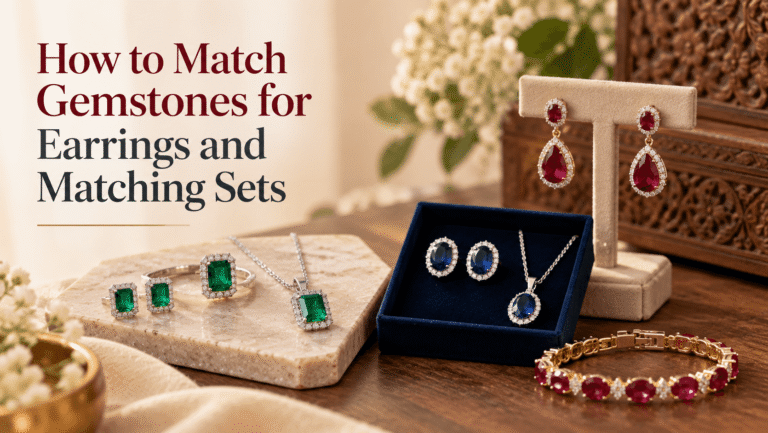
A pair of earrings should look like a pair. When one stone is slightly greener, darker or smaller than the other, even a customer with no gemstone knowledge may feel something is off, even if they cannot say what.
Matching is one of the most underrated skills in jewellery making. It affects how a piece looks, how it sells and how your customers see your quality. This guide explains how professionals match gemstones for earrings, pendants, necklaces and complete sets.
Why Gemstone Matching Is Difficult
Natural gemstones are not made in factories. Every stone forms differently, so two stones from the same mine, even from the same rough crystal, can differ in colour, tone, clarity and shape.
Common problems include:
- One stone looks lighter or darker than the other
- A slight difference in hue, such as a greener emerald next to a bluer one
- Different sizes, even by half a millimetre
- Different cutting styles or depths, which change how light behaves
- Different inclusions, which make one stone look cloudier
Because matching needs more stones to choose from, a perfectly matched pair of fine natural stones is usually priced higher than two unmatched stones of similar quality.
The 6 Factors to Match
1. Colour (the most important)
Colour has three parts, and all three should match:
- Hue: The actual colour, such as green, bluish green or yellowish green
- Tone: How light or dark the stone is
- Saturation: How strong or muted the colour is
Two stones may both look “blue” but differ in saturation, which becomes obvious once they sit side by side in earrings.
Tip: Compare stones under the same light, ideally neutral daylight or a daylight-balanced lamp. Warm showroom lighting can hide differences that appear in natural light.
2. Size and Dimensions
Do not match only by carat weight. Two stones can weigh the same and still look different in size because of differences in depth and cut.
Check:
- Length and width in millimetres
- Height (depth)
- Face-up area, meaning how big the stone looks from the top
For earrings, the face-up appearance matters most, since that is what the viewer sees.
3. Cut and Shape
Both stones should have the same shape (oval, round, pear, cushion and so on) and the same cutting style (faceted, cabochon, rose cut).
Also look at:
- Symmetry of the outline
- Number and arrangement of facets
- Quality of polish
- Depth, because a deeper stone can look darker and a shallower one can look lighter or “windowed”
For pear and marquise shapes, make sure both stones are true mirror images of each other, not just similar in shape.
4. Clarity and Inclusions
Natural gemstones have inclusions, but the visible effect should be similar in both stones. If one stone is eye-clean and the other has a visible feather or cloud, the pair will look uneven.
For stones that are normally included, such as emerald, aim for similar inclusion levels and similar visibility. Placement also matters. A visible inclusion in the centre will bother the eye more than one near the edge.
5. Treatment Status
Never mix treated and untreated stones in a pair without a clear reason. Different treatments can also change how stones behave over time.
Ideally, both stones should:
- Have the same type and level of treatment
- Come from the same parcel or lot
- Be documented in the same way
This also keeps your disclosure simple and honest.
6. Origin and Material Consistency
Where possible, match stones from the same source. Stones from different localities can look similar at first but differ in undertone, glow or fluorescence under different lights.
Matching Different Types of Jewellery
Earrings
Earrings are the hardest to match because they are worn side by side. Colour, size and cut should be as close as possible. Even small differences become noticeable.
Stud Earrings
Studs are viewed face-up and close together, so face-up size and colour consistency are critical.
Drop and Dangle Earrings
Check that length, shape and visual weight are balanced. Both stones should hang the same way and catch the light similarly.
Pendants and Necklaces
A single centre stone needs no pair, but a necklace with several stones should show smooth, graduated or consistent colour from one stone to the next.
Complete Sets (Ring, Earrings, Necklace, Bracelet)
For a set, you need consistency across several pieces. The colours should belong to the same family, and the style, cut and metal work should feel unified. Identical stones are not always needed. A slight, intentional gradation, such as light to deep blue, can look beautiful in a necklace.
Rows and Bracelets with Many Stones
Calibrated (uniformly sized) stones are used here. Check colour consistency across the entire strand, not only a few sample stones.
Step-by-Step: How Professionals Match Gemstones
- Start with a large parcel. The more stones you can sort through, the better your chance of true matches.
- Sort by shape and size. Group stones of the same shape and similar dimensions.
- Separate by colour family. Divide by hue, then by tone and saturation.
- View under neutral light. Use daylight-balanced lighting on a plain white or neutral surface.
- Compare face-up and side-on. View from the top, then check depth and profile.
- Test in different lighting. Check in sunlight, shade and indoor light. Good matches stay consistent.
- Set a trial pair in a mounting or on a white card. Placing stones side by side shows differences that single-stone viewing hides.
- Review again after setting. The metal colour, prong placement and back-closure affect the stone’s appearance, so final checks should happen after stone setting.
Does the Metal Affect Matching?
Yes. Yellow gold, white gold and rose gold reflect different tones into the stone. A gemstone can look slightly different in each metal, and a closed-back setting can darken a stone compared with an open-back setting.
This means all pieces in a matching set should use the same metal colour and setting style, or the stones may appear mismatched even when they are not.
Calibrated vs. Non-Calibrated Stones
- Calibrated stones are cut to standard sizes (for example 5 mm round, or 8 x 6 mm oval). They are easier to match and fit into standard mountings, which makes them popular in volume production.
- Non-calibrated (freesize) stones are cut to maximise weight or beauty from the rough. They need custom-made settings and more careful matching.
Buyers who want consistent production often prefer calibrated stones, while high-end custom pieces may use freesize stones.
Common Mistakes to Avoid
- Matching by carat weight only. Always check dimensions and face-up appearance.
- Judging colour under warm shop lights. Always verify in neutral light.
- Ignoring depth. A deep stone and a shallow stone can look like different colours.
- Mixing treatments. This can create visible differences and disclosure issues.
- Not checking after setting. Metal and setting style change the final look.
- Comparing stones separately. Always view the pair side by side.
Tips for Wholesale Buyers
- Ask for matched pairs separately. Most suppliers can pre-match stones, but this may involve an extra cost.
- Define tolerance. Agree what difference in size (for example, within 0.1 to 0.2 mm) and colour is acceptable.
- Approve a sample. Review a sample pair or set before bulk production.
- Keep parcels together. Stones from the same lot are usually easier to match.
- Plan for extra stones. Matching often requires more stones than the final piece count, so ask your manufacturer about wastage and sourcing.
- Choose a manufacturer who selects stones in-house. A team that does stone selection, matching and setting under one roof can maintain consistency from start to finish.
Quick Checklist: Is It a Good Match?
| Check | Match? |
|---|---|
| Same hue, tone and saturation | ☐ |
| Same dimensions and face-up size | ☐ |
| Same shape and cutting style | ☐ |
| Similar depth and profile | ☐ |
| Similar clarity and inclusion visibility | ☐ |
| Same treatment type | ☐ |
| Consistent in daylight and indoor light | ☐ |
| Consistent after setting in the metal | ☐ |
About Bhavya Gems & Jewels
Bhavya Gems & Jewels is a B2B jewellery manufacturer and wholesaler based in Jaipur with over 30 years of experience. Our manufacturing process includes gemstone selection, stone setting and lab testing, which helps us deliver consistent pairs and sets in every order.
Explore our earrings collection, browse our gemstones, see our manufacturing process, or send us an enquiry for custom matched jewellery.
Email: bhavya@bhavyagemsandjewels.com | Phone: +91 96360 37445
FAQs
Q1. Why are matched gemstone pairs more expensive?
A matched pair requires sorting through many stones to find two that are close in colour, size, cut and clarity. The extra selection effort, and the stones left over, add to the cost.
Q2. Do both stones in earrings have to be identical?
They should be very close, but natural stones are never perfectly identical. The goal is that the difference is not noticeable to the eye when the earrings are worn.
Q3. Is it better to use calibrated or freesize stones for earrings?
Calibrated stones are easier to match and good for volume production. Freesize stones can offer higher beauty and weight yield but need more careful matching and custom settings.
Q4. Can lab-grown stones be matched more easily?
Often yes, because lab-grown stones can be produced with more consistent colour and clarity. They must still be sold and labelled as lab-grown.
Q5. How do I check if two gemstones match?
Place them side by side on a white surface under neutral daylight, compare colour, size, shape and clarity from the top and side, and re-check after setting.
Q6. Does the setting affect how well gemstones match?
Yes. Metal colour, open or closed backs and prong style can all change how a stone looks, so use the same setting style for both stones.