
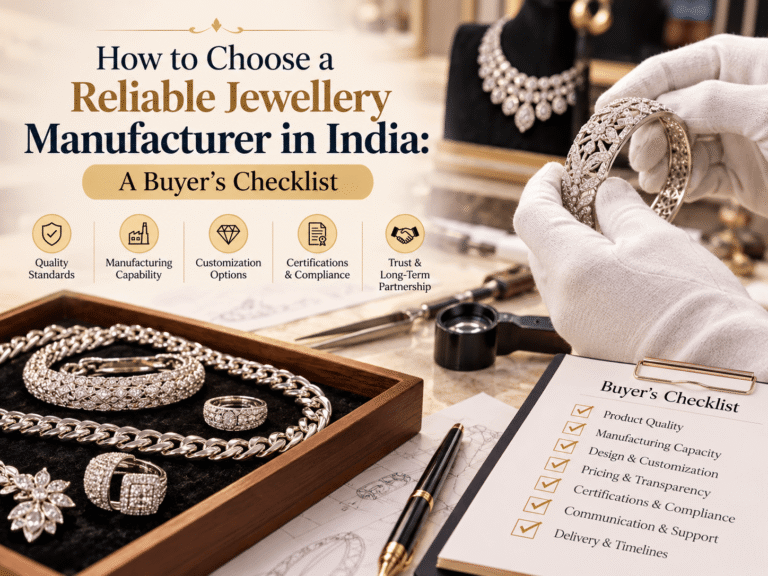
India is one of the world’s biggest jewellery-making countries. Cities like Jaipur, Mumbai, Surat and Hyderabad supply gold, diamond, silver and gemstone jewellery to retailers and designers across the globe. This also means buyers have hundreds of manufacturers to choose from, and not all of them deliver the same quality, timelines or honesty.
The wrong manufacturer can cost you money, delay your launch and damage your brand’s reputation. The right one becomes a long-term partner who grows with your business.
This checklist will help you evaluate any jewellery manufacturer in India before placing your first order.
1. Check Their Experience and Specializatio
Experience in jewellery manufacturing is not just about the number of years. Look at what kind of jewellery they actually specialize in.
Some factories are strong in machine-made lightweight gold. Others focus on handcrafted pieces with stone setting. Ask for their areas of expertise, such as:
- Fine gold jewellery
- Diamond jewellery
- Silver or brass jewellery
- Traditional styles like Hyderabadi, Kundan or Polki
- Vintage-inspired styles like Victorian and Art Deco
A manufacturer with decades of experience in your category will understand finishing, stone setting and design details far better than a generalist.
2. Confirm They Are a Real Manufacturer, Not Just a Trader
This is one of the most important checks. Many suppliers present themselves as manufacturers but outsource production to others, which means less control over quality and delivery.
Ask them:
- Do you have your own factory or workshop?
- Can I see photos or a video of your production floor?
- Can I visit your unit or arrange a virtual tour?
A genuine manufacturer will be happy to show you the process.
3. Understand Their Manufacturing Process
A professional jewellery manufacturer follows a clear, documented workflow. A typical process includes:
- Design (manual sketch or CAD)
- Model making
- Casting
- Filing and finishing
- Stone setting
- Polishing
- Quality control and lab testing
Ask whether CAD design and in-house casting are available. In-house capability means faster turnaround, better consistency and fewer communication gaps.
4. Ask About Quality Control and Certification
Quality problems are the number one reason buyers switch suppliers. Before ordering, ask:
- How do you inspect finished pieces?
- Do you test gemstones and diamonds in a lab?
- Are your pieces hallmarked?
- Which certification partners or memberships do you hold?
For gold jewellery sold in India, BIS hallmarking is mandatory. For diamonds, certificates from recognized labs add trust for your end customers. Always ask to see sample certificates.
5. Evaluate Design and Customization Ability
If you want to build your own brand, your manufacturer should be able to work from your ideas, not just sell you catalogue designs.
Check whether they can:
- Convert your sketch or reference photo into a CAD model
- Create samples before bulk production
- Offer private label or custom branding
- Modify metal, stone or finish options
A good partner will give design input too, not just follow instructions.
6. Clarify MOQ (Minimum Order Quantity)
Every manufacturer has a minimum order requirement. It may be based on pieces, weight or value, and it often differs for ready designs versus custom designs.
If you are a new or small business, ask upfront:
- What is the MOQ for catalogue designs?
- What is the MOQ for custom designs?
- Is there flexibility for first-time orders or sample runs?
Never assume. Get it in writing.
7. Get Transparent Pricing
Jewellery pricing usually includes metal cost, making charges, stone cost and finishing. A trustworthy manufacturer will explain this breakdown clearly.
Be careful of:
- Prices that look far lower than the market
- Vague “all-inclusive” quotes with no details
- No clarity on how gold rate fluctuations are handled
Ask how pricing is locked: at order confirmation, at advance payment, or at delivery.
8. Review Sampling and Approval Process
Always order samples before committing to a large order. Good manufacturers have a clear process:
- Sample timeline and cost
- Approval stage before bulk production
- Written approval of specifications such as weight, size, stone quality and finish
This protects both sides and avoids disputes later.
9. Check Delivery Timelines and Reliability
Jewellery businesses depend heavily on seasons such as weddings, festivals and holidays. A delay of two weeks can mean a missed sales window.
Ask about:
- Standard production lead time
- Rush order options
- Past on-time delivery record
- Packaging and insured shipping arrangements
10. Look for Export Experience (If You Are Buying from Abroad)
If you are an international buyer, work with a manufacturer who understands export documentation, shipping, customs and compliance. Experience with international clients usually means better communication, better packaging and fewer surprises.
11. Verify Reputation and References
Do your homework:
- Check their website, social media and business listings
- Look for trade show participation, for example IIJS (India International Jewellery Show)
- Ask for references from existing B2B clients
- Read genuine reviews and testimonials
Long-term relationships with retailers and designers are one of the strongest signs of reliability.
12. Evaluate Communication and Support
Even the best factory can be hard to work with if communication is poor. Notice how they respond during your first conversations:
- Do they reply promptly?
- Are answers clear and specific?
- Do they share updates during production?
- Are they open about problems if something goes wrong?
Good communication in the early stage usually continues after the order is placed.
Quick Buyer’s Checklist
| # | Check | Done |
|---|---|---|
| 1 | Experience in your jewellery category | ☐ |
| 2 | Own factory, not just a trader | ☐ |
| 3 | Clear manufacturing process (CAD, casting, finishing) | ☐ |
| 4 | Quality control, hallmarking, lab testing | ☐ |
| 5 | Custom and private label ability | ☐ |
| 6 | MOQ clearly stated | ☐ |
| 7 | Transparent pricing | ☐ |
| 8 | Sampling and approval process | ☐ |
| 9 | Reliable delivery timelines | ☐ |
| 10 | Export experience (if needed) | ☐ |
| 11 | Reputation and references | ☐ |
| 12 | Responsive communication | ☐ |
Why Jaipur Is a Smart Place to Source Jewellery
Jaipur has been known for centuries as a centre for gemstones, enamel work and traditional craftsmanship. Today it combines skilled artisans with modern CAD and casting technology. The city is home to dedicated jewellery manufacturing zones, which makes sourcing, finishing and stone setting efficient and cost-effective for buyers.
About Bhavya Gems & Jewels
Bhavya Gems & Jewels is a B2B jewellery manufacturer and wholesaler based in Jaipur with over 30 years of experience in handcrafting fine jewellery. Our expertise includes Fine Gold, Victorian/Art Deco and Hyderabadi jewellery, supported by in-house processes from design and casting to stone selection and lab testing.
If you are looking for a long-term manufacturing partner, you can explore our products, learn about our manufacturing process, or send us an enquiry.
Contact: bhavya@bhavyagemsandjewels.com | +91 96360 37445
FAQs
Q1. How do I know if a jewellery manufacturer is genuine?
Ask for factory photos or a virtual tour, business registration details, certifications, and references from existing B2B clients.
Q2. What is the difference between a jewellery manufacturer and a wholesaler?
A manufacturer makes the jewellery in its own facility, while a wholesaler may buy from different makers and resell in bulk. Some businesses do both.
Q3. Can I order custom jewellery designs in small quantities?
It depends on the manufacturer. Many have different MOQs for catalogue and custom designs, so confirm this before you start.
Q4. Why is Jaipur popular for jewellery manufacturing?
Jaipur has a long tradition of gemstone and jewellery craftsmanship, skilled artisans and dedicated manufacturing zones.