
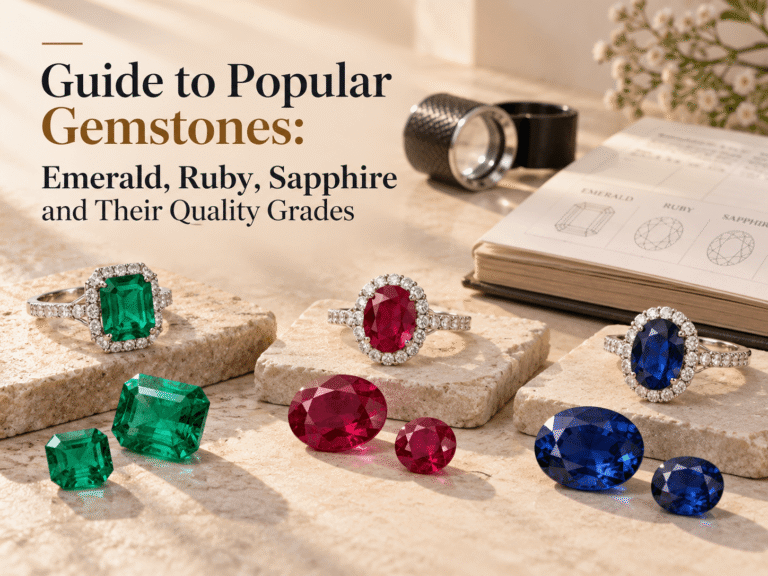
merald, ruby and sapphire are three of the most loved coloured gemstones in the world. They appear in royal collections, bridal jewellery and high-end designer pieces, and demand for them keeps growing among retailers and brands.
But buying gemstones is very different from buying metal. Two stones that look similar can differ greatly in price, depending on origin, treatment and quality. This guide explains each gemstone and how its quality is judged, so you can source with confidence.
How Coloured Gemstones Are Graded
Unlike diamonds, coloured gemstones do not have one universal grading scale. Most professionals evaluate them using these factors, in roughly this order of importance:
- Colour: Hue (the actual colour), tone (light or dark) and saturation (intensity). For coloured stones, colour is the biggest value driver.
- Clarity: How many inclusions (internal features) are visible, and how much they affect the look of the stone.
- Cut: How well the stone is shaped and polished to show its colour and brilliance.
- Carat weight: Larger stones of good quality are rarer, so price per carat rises sharply with size.
- Origin and treatment: Where the stone comes from and whether it has been enhanced.
Clarity expectations differ by gemstone type
Labs such as GIA group coloured stones by how commonly they contain inclusions:
- Type I: Usually clean to the eye, such as aquamarine
- Type II: Often have some inclusions, such as ruby and sapphire
- Type III: Almost always included, such as emerald
This is why an emerald with visible inclusions can still be considered fine quality, while the same level of inclusions in an aquamarine would be a drawback.
Emerald
About the stone
Emerald is the green variety of the mineral beryl. Its colour comes mainly from chromium and sometimes vanadium. It has a hardness of about 7.5 to 8 on the Mohs scale, but it is often brittle because of natural fractures, so it needs careful setting and handling.
Major sources
Colombia, Zambia and Brazil are well-known sources, with other deposits found in several countries.
How emerald quality is judged
| Factor | What to look for |
|---|---|
| Colour | Vivid, rich green to slightly bluish green, medium to medium-dark tone, even colour with no heavy dark or pale patches |
| Clarity | Inclusions are expected. The aim is a stone that looks lively and attractive to the eye |
| Cut | Emerald cut and cabochon are popular, designed to protect the stone and show its colour |
| Treatment | Clarity enhancement with oil or resin is very common and widely accepted when disclosed |
Buying tips
- Ask for the treatment level (none, minor, moderate or significant)
- Check that the stone’s edges and corners are not chipped
- Be careful with very low prices, as glass or synthetic stones are sometimes passed off as natural
Ruby
About the stone
Ruby is the red variety of corundum. Its colour comes from chromium. It has a hardness of 9 on the Mohs scale, which makes it very durable and suitable for daily-wear jewellery such as rings.
Major sources
Myanmar (Burma), Mozambique, Thailand, Sri Lanka and Madagascar are among the well-known sources.
How ruby quality is judged
| Factor | What to look for |
|---|---|
| Colour | Strong, vivid red, often with a slight hint of blue or pink. Too dark or too light reduces value |
| Clarity | Most rubies have some inclusions. Cleaner stones are rarer and more valuable |
| Cut | Well-proportioned shapes that avoid dull or “windowed” areas |
| Treatment | Heat treatment is very common. Untreated rubies of fine quality command a large premium. Fracture-filled or glass-filled rubies are worth much less and should always be disclosed |
Terms you may hear
“Pigeon’s blood” is a trade term for the most prized red colour. It is a marketing description, not a strict scientific grade, so always look at the stone and the lab report, not just the label.
Buying tips
- Ask whether the stone is heated, unheated or filled
- For high-value stones, request an independent lab certificate
- Compare stones under good, neutral lighting
Sapphire
About the stone
Sapphire is corundum in any colour except red. Blue is the most famous, but sapphires also come in pink, yellow, green, purple, orange and colourless. Hardness is 9, the same as ruby, so sapphires are excellent for everyday jewellery.
Major sources
Sri Lanka, Madagascar, Myanmar, Kashmir (historic, extremely rare) and several other regions.
How sapphire quality is judged
| Factor | What to look for |
|---|---|
| Colour | Rich, saturated blue (often described as royal blue or cornflower blue) with good tone, not too dark or washed out |
| Clarity | Fewer visible inclusions are better, though some fine stones show natural silk |
| Cut | Even colour distribution and good brilliance |
| Treatment | Heat treatment is standard in the trade. Untreated stones of fine quality are rarer and priced higher |
Fancy sapphires
Pink, yellow, green and other colours are known as fancy sapphires. Padparadscha, a delicate pinkish-orange sapphire, is among the rarest and most valuable.
Buying tips
- Confirm the colour looks consistent from different angles
- Check for treatment disclosure
- Ask about origin only if a lab report supports it
Quick Comparison
| Emerald | Ruby | Sapphire | |
|---|---|---|---|
| Mineral | Beryl | Corundum | Corundum |
| Colour | Green | Red | Blue and many other colours |
| Mohs hardness | 7.5 to 8 | 9 | 9 |
| Typical clarity | Usually included | Often included | Often cleaner |
| Common treatment | Oil or resin | Heat, sometimes filling | Heat |
| Everyday wear | Needs care | Very durable | Very durable |
Natural, Treated and Synthetic Stones: Know the Difference
- Natural, untreated: Mined and only cut and polished. These are the rarest and most expensive.
- Natural, treated: Mined stones enhanced by heat, oil or other methods. This is very common and perfectly acceptable when properly disclosed.
- Lab-grown (synthetic): Made in a laboratory with the same chemical composition as natural stones. They are real gemstones, but are priced much lower and must be sold as lab-grown.
- Imitations: Glass or other materials that only look like gemstones.
The golden rule is simple: disclosure builds trust. Always know what you are buying and tell your customers what they are getting.
Why Certification Matters
For valuable stones, an independent lab report gives you proof of identity, treatment and sometimes origin. Well-known gemmological laboratories include GIA, IGI, GRS, Gübelin and SSEF. Which lab suits you depends on the stone’s value and your market, so ask your supplier which reports are available.
6 Tips for Buying Gemstones in Bulk
- Start with a sample lot before placing a large order.
- Match stones carefully. For earrings and sets, colour and size matching is critical.
- Check consistency across the whole parcel, not just the best stones.
- Get treatment details in writing on your invoice or memo.
- View under neutral light to judge true colour.
- Work with a manufacturer who tests stones. In-house gem selection and lab testing reduce risk.
About Bhavya Gems & Jewels
Bhavya Gems & Jewels is a B2B jewellery manufacturer and wholesaler based in Jaipur, with over 30 years of experience in fine jewellery. Our process includes careful gemstone selection and lab testing of stones, so your jewellery is built on quality material.
Browse our gemstone collection, see our manufacturing process, or contact us for custom gemstone jewellery.
Email: bhavya@bhavyagemsandjewels.com | Phone: +91 96360 37445
FAQs
Q1. Which is more valuable: emerald, ruby or sapphire?
It depends on quality. Fine, untreated rubies often command very high prices per carat, but top-quality examples of all three can be extremely valuable.
Q2. Is heat-treated ruby or sapphire acceptable?
Yes. Heat treatment is a long-standing, widely accepted practice in the trade, as long as it is disclosed.
Q3. Are emeralds always included?
Most natural emeralds have inclusions. These are often called “jardin” and are considered part of the stone’s character.
Q4. Which gemstone is best for everyday jewellery?
Ruby and sapphire are the most durable at hardness 9. Emeralds can be worn daily too, but they need more careful design and handling.
Q5. How can I be sure a gemstone is natural?
Ask for a report from a recognized gemmological laboratory, and buy from a supplier who tests and discloses treatments.