
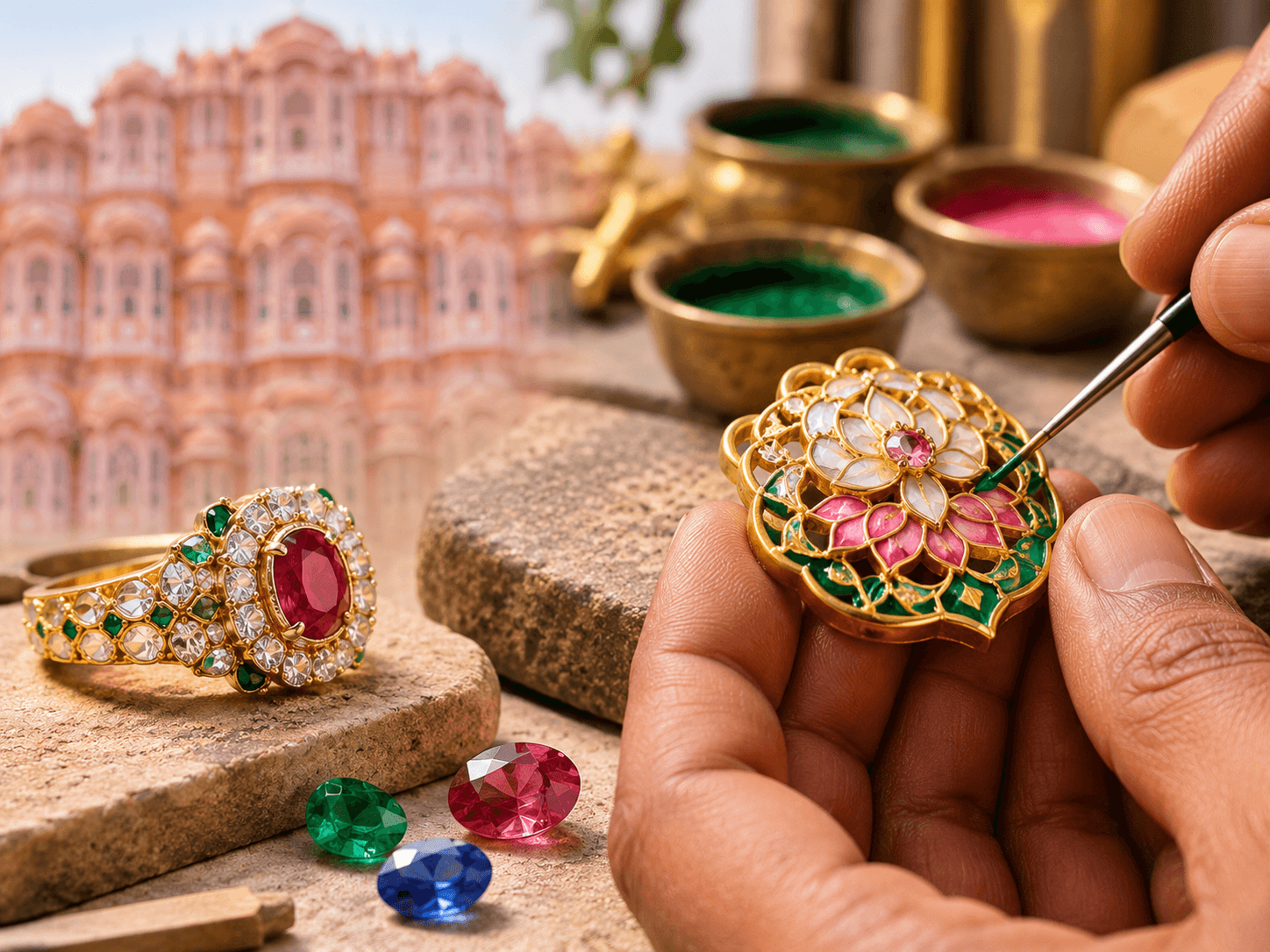
Hold a piece of Jaipur jewellery and turn it over. Many buyers are surprised to find the back is as beautiful as the front: a rich pattern in red, green and blue enamel, finished with the same care as the stones on top.
That attention to detail is why Jaipur has such a strong name in gemstone cutting and enamel work. Retailers and designers around the world source from here, not only because of price, but because of skills that take years to learn and generations to refine.
This blog explains why Jaipur artisans are so respected, how their craft works and what to look for when sourcing.
A Craft Tradition Built on Royal Patronage
Jaipur was founded in 1727 by Maharaja Sawai Jai Singh II. Like many royal courts of Rajasthan, the rulers of Jaipur supported artists, goldsmiths, gem cutters and enamellers. Skilled craftsmen settled in the city, and their knowledge passed from one generation to the next, often within the same families.
This is the key to Jaipur's reputation. The skill is not new or recently imported. It has been built over centuries, in workshops where children grew up watching their elders work.
Gemstone Craft: Why Jaipur Stands Out
Jaipur is widely known as a centre for coloured gemstones. Stones such as emerald, ruby, sapphire, amethyst, garnet, topaz, tourmaline and many others are cut, polished and traded here.
What Makes Jaipur's Gemstone Work Special
- Cutting expertise. A good cut brings out the colour and brilliance of a stone while keeping as much weight as possible. Experienced cutters read each rough stone and decide the best shape.
- Variety of cuts. Artisans work in faceted cuts, cabochons, rose cuts and carved shapes, matching the cut to the design.
- A full ecosystem. Rough dealers, cutters, polishers, sorters and jewellers work close to each other, so stones move quickly from raw material to finished jewellery.
- Access to choice. Buyers can see a wide range of stones, colours and sizes in one place, which helps with custom designs and matched sets.
- Hand-finishing. Even with modern tools, much of the final judgement is done by trained eyes and hands.
What This Means for Buyers
- Wider choice of stones for your designs
- Better matching of pairs and sets
- Quicker sourcing for custom orders
- Competitive pricing because many steps happen in one city
Enamel Work (Meenakari): The Art of Colour on Metal
Meenakari is the craft of decorating metal with coloured enamel, which is mineral-based colour that is fused to the surface by heat. It is one of the most celebrated crafts of Rajasthan, and Jaipur is among its best-known centres.
Many sources trace Meenakari in Rajasthan to the Mughal-era courts and to craft traditions that came from Persia. Over time, Jaipur's artisans developed their own style, known for rich colours and fine detail.
How Meenakari Is Made
- Design and engraving. The goldsmith creates the piece and engraves fine channels or patterns where enamel will sit.
- Colour preparation. The enamel colours are prepared and applied by hand into the engraved areas.
- Firing. The piece is heated in a kiln so the enamel melts and bonds to the metal.
- Repeat and refine. Different colours often need separate rounds of firing. The artisan applies, fires, checks and corrects, step by step.
- Polishing and finishing. The surface is polished so the colours look smooth and vibrant.
Because colours react differently to heat, Meenakari takes patience and experience. A single mistake in firing can damage the work, which is why skilled enamellers are so valued.
Typical Meenakari Features
- Deep reds, greens, blues and whites
- Floral, peacock, leaf and geometric motifs
- Enamel on both the front and back of the piece
- Combination with Kundan, polki and gemstones
Where Gemstones and Enamel Come Together
The real beauty of Jaipur jewellery shows when both crafts meet in one piece. A necklace may carry polki or emeralds on the front and a detailed Meenakari design on the reverse. Earrings may use enamel for background colour and gemstones for sparkle.
This combination is popular in:
- Bridal jewellery: necklaces, chokers, tikkas and earrings
- Statement earrings: chandbalis, jhumkas and drops
- Bangles and kadas: with enamel patterns and stone detailing
- Pendants and sets: traditional and fusion styles
- Vintage-inspired jewellery: where enamel adds period character
It also connects well with Hyderabadi jewellery, where pearls, Jadau and enamel are often seen together.
Why Global Buyers Source Gemstone and Enamel Jewellery from Jaipur
| Reason | What It Means for You |
|---|---|
| Inherited skills | Detail and finish that are hard to copy |
| Complete supply chain | Stones, metal work, enamel and finishing nearby |
| Customization | Designs can be adapted in colour, stones and motifs |
| Handcrafted character | Each piece has depth, not a mass-produced look |
| Competitive pricing | Strong value for detailed handwork |
| Export experience | Many manufacturers are used to international orders |
What Makes a Good Meenakari Piece?
When you inspect enamel jewellery, check these points:
- Colour evenness. Colours should look uniform, with no patchy or dull areas.
- Clean edges. Enamel should stay within its lines, with no bleeding between colours.
- Smooth surface. There should be no bubbles, pits or rough spots.
- No cracks or chips. Check corners and edges closely.
- Back finishing. The reverse should be neat and detailed, which shows true craftsmanship.
- Metal quality. Confirm purity and hallmarking for gold pieces.
What Makes a Good Gemstone Finish?
- Even cutting. The stone should be symmetrical, with a clean outline.
- Good polish. Facets should look sharp, without scratches or a cloudy surface.
- Colour consistency. Matched stones in earrings and sets should look alike.
- Secure setting. Stones should sit firmly, with no movement.
- Honest disclosure. Treatments and whether stones are natural or lab-grown should be stated clearly.
Tips for Retailers and Designers Ordering Enamel and Gemstone Jewellery
- Ask for samples. Handcrafted colour work should be approved before bulk production.
- Agree on colour references. Share colour swatches or photos, since enamel shades can differ slightly from batch to batch.
- Plan lead time. Hand enamel and detailed stone setting take longer than plain jewellery.
- Confirm durability and care. Ask how the pieces should be cleaned and stored. Enamel and some gemstones need gentle handling.
- Check consistency across the batch. Look at several pieces, not only the best sample.
- Discuss MOQs and customization. Many manufacturers allow custom colours and motifs, but terms vary.
- Look at the back of the piece. It is often the best indicator of craftsmanship.
Care Tips You Can Share with Your Customers
- Keep enamel jewellery away from perfumes, sprays and harsh chemicals
- Store pieces separately in soft pouches to avoid scratches
- Wipe gently with a soft, dry cloth
- Avoid wearing during exercise, swimming or bathing
- Be careful with knocks, since enamel can chip on impact
About Bhavya Gems & Jewels
Bhavya Gems & Jewels is a B2B jewellery manufacturer and wholesaler based in Jaipur with over 30 years of experience. We craft Fine Gold, Victorian / Art Deco and Hyderabadi jewellery, with gemstone selection, stone setting and lab testing as part of our process.
Explore our gemstones, Hyderabadi collection, earrings and necklaces, see our manufacturing process, or send us an enquiry for custom and wholesale orders.
Factory: G-42 (A) E.P.I.P. Jewellery Zone, Sitapura, Jaipur 302022
Office: 101, Vardhman Complex, Johri Bazar, Jaipur 302003
Email: bhavya@bhavyagemsandjewels.com
Phone: +91 96360 37445
Frequently Asked Questions
Why is Jaipur famous for gemstone work?
Jaipur has a long tradition of gem cutting and polishing, a large community of skilled cutters and traders, and easy access to a wide range of coloured stones.
What is Meenakari?
Meenakari is the craft of decorating metal with coloured enamel that is fused onto the surface by firing it in a kiln. It is widely associated with Rajasthan, including Jaipur.
What is the difference between Meenakari and Kundan?
Meenakari is enamel work, while Kundan is a traditional way of setting stones in gold. The two are often combined in a single piece.
Is Meenakari jewellery durable?
Enamel is hard but can chip if hit or dropped. With gentle handling and proper storage, well-made pieces last for many years.
Can I order custom colours in Meenakari jewellery wholesale?
Many manufacturers offer custom colour and motif options. Confirm MOQ, sampling and lead times with your supplier.
Can enamel and gemstones be combined in one design?
Yes, and this combination is a hallmark of Jaipur jewellery, especially in bridal and statement pieces.